10 Years of CSR Spending in India: Top Funded Sectors and Strategic Insights
India’s CSR ecosystem has spent billions in the social development sector in the last decade. But where is this money actually going? What are the gaps that corporate India needs to fill strategically?
Based on a decade of sector-wise CSR data from the Ministry of Corporate Affairs (MCA) CSR Portal, this analysis breaks down the top CSR funding sectors in India between FY15 and FY24, including Education, Healthcare, Livelihood Enhancement, Environmental Sustainability, and Skill Development.
The data reveals clear distinctions between well-funded and underfunded sectors, while highlighting the gradual and sometimes dramatic shifts in CSR investment patterns over the last ten years.
Whether you are a CSR leader, NGO fundraiser, ESG professional, or donor advisor, understanding these data trends can help identify funding opportunities, underserved sectors, and strategic investment gaps.
More than a Decade of CSR Spending: What data shows
What started as compliance-driven philanthropy has now become a strategic investment in long-term social development. Across seven key development sectors including Education, Healthcare, Rural Development, Livelihood Enhancement, Environmental Sustainability, Poverty & Hunger Eradication, and Vocational Skills- total CSR spending has grown dramatically, with some sectors seeing multifold increases.
An analysis of CSR spending trends from FY15 to FY24 reveals a clear shift in corporate priorities and emerging focus areas. For CSR professionals and strategy teams, understanding these dynamics is essential to making investment decisions that are both impactful and differentiated.
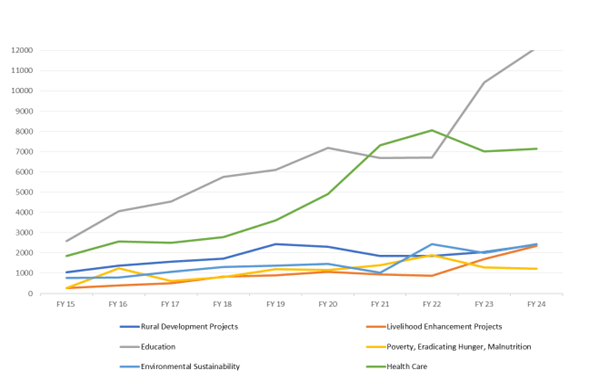
Figure 1: Sector-wise CSR spending trends in India based on Ministry of Corporate Affairs (MCA) data from FY15–FY24.
Education- The Undisputed Leader and Its Implications
Education has been the dominant CSR category throughout the decade, and FY24 cemented its lead with a staggering ₹12,135 crore- nearly double the second-largest sector (Healthcare at ₹7,151 crore). Education spending in FY24 alone exceeds the combined total of all other six development sectors tracked. The concentration is striking and strategic.
What this means for your CSR strategy: The dominance of education signals that India Inc. has a strong consensus on this theme. For companies entering this space, differentiation matters more than volume. The most impactful programmes now are those tackling foundational learning outcomes, STEM for girls, digital literacy in Tier 3 cities and rural areas, and bridge programmes for school dropouts- areas where aggregate spending remains thin despite the overall headline number.
For NGOs, this means education-focused projects continue to have strong fundraising potential, especially when backed by data, outcomes, and scalability.
Healthcare- A Major CSR Priority Post-COVID
Healthcare witnessed one of the sharpest increases in CSR support over the years. Funding rose from around ₹1,847 crore in FY15 to a peak of ₹8,049 crore in FY22, due to COVID, and stabilized above ₹7,000 crore in subsequent years. Companies acted based on the need of the hour and responded to the need for continued investment in the health sector in India.
Strategic takeaway: Healthcare infrastructure- especially in rural and semi-urban India, still has a massive unmet need. Companies not already active here can find high-impact entry points in maternal & child health, mental health awareness, and preventive screening programmes, where CSR crowding is far lower than in hospital-building or medical camps.
NGOs working in preventive healthcare, elder care, mental health, and palliative support are seeing growing donor interest. Health and education remain significantly higher in terms of attracting funding compared to other sectors.
The Rapidly Expanding: Livelihood and Skill Development Sector
Livelihood enhancement and vocational skill training have become key CSR themes as India focuses on employability and workforce readiness. Here is the number that should stop every CSR strategist in their tracks: Livelihood Enhancement spending grew from just ₹280 crore in FY15 to ₹2,360 crore in FY24- a 743% increase, making it the fastest-growing CSR sector in absolute percentage terms over this period
Yet in absolute rupee terms, it remains a fraction of Education or Healthcare allocations. This creates a compelling strategic window for companies entering the sector.
Key areas attracting CSR support include:
- Youth employability programs
- Nursing assistant training
- Technical and vocational education
- Women-led entrepreneurship
- Digital and financial literacy
- Placement-linked skilling programs
Companies increasingly prefer outcome-driven skill development models that demonstrate placements, income growth, and sustainable employment generation.
This sector is expected to continue growing as India’s young population enters the workforce.
Environmental Sustainability: An ESG Alignment Opportunity for CSR spending in India
Environmental sustainability funding has shown stable and increasing corporate commitment, reaching approximately ₹2,430 crore in FY24, the highest since 2015.
With ESG reporting becoming more important globally, environmental CSR projects are no longer treated as optional philanthropy. They are becoming part of long-term sustainability strategies.
After a dip in FY21 (likely due to COVID-related reallocation), environmental CSR bounced back sharply. For companies with strong ESG commitments or those in carbon-intensive industries, environmental CSR is no longer optional. It is becoming a core part of demonstrating genuine sustainability commitment to investors, regulators, and stakeholders alike.
Key areas attracting CSR support include:
- Afforestation and biodiversity
- Clean water and rejuvenation
- Renewable energy access for rural communities
- Plastic and waste management initiatives
- Support for vulnerable communities
| Sector | FY15 (₹ Cr) | FY21 (₹ Cr) | FY24 (₹ Cr) | FY15→FY24 Growth |
| Education | 2,589 | 6,693 | 12,135 | +369% |
| Health Care | 1,848 | 7,326 | 7,151 | +287% |
| Rural Development | 1,059 | 1,851 | 2,408 | +127% |
| Livelihood Enhancement | 280 | 939 | 2,360 | +743% |
| Env. Sustainability | 774 | 1,030 | 2,430 | +214% |
| Poverty & Hunger | 275 | 1,408 | 1,234 | +349% |
| Vocational Skills | 277 | 718 | 1,397 | +404% |
*Figures based on sector-wise CSR spending data from the Ministry of Corporate Affairs (MCA) CSR Portal data.
Insights for Your CSR Stategy
1. Audit Your Portfolio Against Sector Trends:
If your company’s CSR allocations are heavily weighted toward Education and Healthcare, the two dominant sectors- ask whether you are achieving genuine additionality or simply contributing to already well-funded causes. The impact-per-rupee calculus may favour pivoting some allocation to faster-growing, underfunded sectors like Livelihood Enhancement or Vocational Skills.
2. Align CSR with BRSR and ESG Reporting
Environmental Sustainability and Livelihood Enhancement CSR programmes are uniquely well-positioned to generate the kind of measurable, verifiable outcomes that BRSR reporting demands. If your company is under SEBI’s mandatory BRSR framework, intentional alignment between CSR spending and reportable ESG metrics is no longer just good practice, it is a governance imperative.
3. Look at the FY21–FY24 Recovery Curve
Several sectors dipped during FY21 (Rural Development, Environmental Sustainability, Vocational Skills) before rebounding. Companies that maintained or increased investment during that trough are now best positioned with established ground-level infrastructure and implementing partners in place for long term delivery.
4. Build in Sector Diversification
The most resilient and reputationally robust CSR programmes have diversified portfolios, not simply because it hedges risk, but because interconnected sector investments (e.g., Livelihood + Vocational Skills + Education) compound outcomes in ways that single-sector approaches cannot.
Source: Sector-wise CSR spending data compiled from the official Ministry of Corporate Affairs CSR Portal, Government of India.
Frequently Asked Questions
Which sector receives the highest CSR funding in India?
Education receives the highest CSR funding, accounting for ₹12,135 crore in FY24.
What are the fastest-growing CSR sectors?
Livelihood Enhancement, Vocational Skills, and Environmental Sustainability have shown some of the fastest growth over the past decade.
Where can NGOs find CSR funding opportunities?
NGOs can align projects with high-growth sectors such as employability, skill development, environmental sustainability, and healthcare.
What is the source data for CSR spending in India?
The data is sourced from the Ministry of Corporate Affairs (MCA) CSR Portal.