
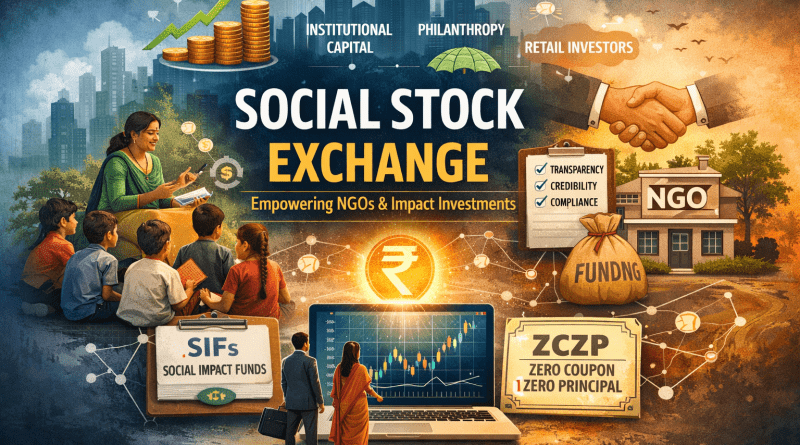
Social Stock Exchange (SSE) India: Opportunities, Challenges, and the Road Ahead
The philanthropic landscape in India is undergoing a massive transformation. The Social Stock Exchange (SSE), regulated by the Securities and Exchange Board of India, is a separate segment within existing stock exchanges like NSE and BSE. It represents a paradigm shift, allowing NGOs (Not-for-Profit Organizations) and social enterprises to raise funds through regulated financial instruments instead of relying only on individual donations or CSR.
If you are a donor looking for verified NGOs seeking sustainable capital, here is everything you need to know about the current state of the SSE.
What is the Social Stock Exchange?
An SSE is essentially a platform on the NSE and BSE that allows For-profit Social Enterprises (FPEs) and Not-for-profit Organisations (NPOs) to raise funds through the stock exchange for specific social causes.
However, it operates quite differently from traditional stock markets:
- Think of the SSE not as a place to buy “shares” for personal profit, but as a regulated marketplace for social credit.
- The “currency” here isn’t a dividend; it’s a Zero Coupon Zero Principal (ZCZP) instrument.
- These are essentially donation-like investments with no financial return.
- When you “buy” a ZCZP, you aren’t expecting your money back.
- Instead, you are buying a guarantee that your money will be used for a specific project, audited by a certified third party, and reported back to you with standardized data.
What is Happening Now: The Current Phase of SSE
The Social Stock Exchange is no longer a conceptual reform—it is active, evolving, and undergoing continuous refinement.
- A Strong Regulatory Push
A major development came in early 2026 when SEBI issued a Master Circular, consolidating all rules related to the SSE. This move simplified compliance, clarified fundraising norms, and strengthened disclosure requirements. This signals one thing clearly: The regulator is committed to making SSE work.
- Continuous Reforms for Inclusivity
Recognising early challenges, SEBI has started refining the framework. These changes aim to bring more inclusivity and flexibility into the system. Recent adjustments include:
- Minimum investment in a ZCZP has been reduced from INR 10,000 to INR 1,000 for retail investors.
- Relaxation of fundraising and registration conditions.
- Extension of timelines for NGOs to raise funds.
- Growing NGO Participation
There is growing awareness and increased onboarding, with NGOs registering on both NSE and BSE platforms. Currently, 150+ NGOs are registered on the NSE and BSE platforms; however, only a small proportion—approximately 5 to 10 percent—have successfully raised funds. Early adopters, including grassroots and skill-development organisations, have begun to leverage the platform. For instance, organisations such as Unnati Foundation demonstrate how SSE listing can enhance transparency and credibility.
However, the transition from registration to actual fundraising remains gradual. This is largely because the onus of mobilising funds continues to rest with the NGOs themselves, while the SSE functions primarily as an enabling platform that facilitates visibility and compliance rather than directly driving capital inflows.
What the SSE is Getting Right
The introduction of the SSE is driving a major cultural shift from informal storytelling to measurable outcomes and, in some cases, impact.
- Building Trust: By mandating disclosures and audits, SSE enhances credibility by shifting trust from informal relationships to verifiable systems. This allows donors and institutions to rely on standardised processes and reporting.
- Creating New Funding Channels: The SSE opens up access to institutional capital, structured philanthropy, and potential retail participation through a formal platform. This helps NGOs gradually reduce dependence on limited and unpredictable traditional funding sources. However, the responsibility of identifying and engaging donors continues to rest with the NGOs themselves.
- Encouraging Measurable Impact: NGOs are now required to define outcomes, track impact, and report progress in a structured manner. This creates a shift from intent-based work to evidence-based impact, improving both clarity and accountability.
- Aligning with Global Trends: Globally, impact investing is growing rapidly, with capital increasingly aligned to social outcomes. India’s SSE positions the country within this movement by integrating social impact with formal financial systems.
The Ground Reality: Where the System Struggles
Despite its strong conceptual foundation, the SSE is currently benefiting only a small segment of NGOs.
India’s NGO ecosystem is vast, with many organisations operating at the grassroots level with limited administrative capacity and qualitative approaches. The SSE framework, being compliance-heavy and documentation-intensive, does not naturally fit these realities. To participate effectively, NGOs must manage legal documentation, financial reporting, social audits, and continuous disclosures. For smaller organisations, these shifts focus from fieldwork to administrative processes, making participation difficult.
Furthermore, unlike traditional markets, SSE investments often do not offer financial returns and instead focus on social impact. Many investors are still adapting to this idea, leading to slower participation. Although registrations are increasing, actual capital raised remains modest, showing a gap between onboarding and real outcomes.
The “Credibility vs. Capacity” Paradox
Currently, SSE participation is skewed toward established, urban-based NGOs with professional management systems. Grassroots organisations often lack the capacity to meet requirements, leaving them underrepresented.
| Feature | Large/Urban NGOs | Small/Grassroots NGOs |
| Compliance Cost | Manageable; they already have audit systems. | High burden; audit fees and data tracking are often too expensive. |
| Visibility | High; they have marketing teams to attract investors. | Low; they struggle to compete for attention on a national exchange. |
| Eligibility | Easy to meet the ₹50 lakh annual spend / ₹10 lakh fundraise criteria. | Many grassroots NGOs fall below these financial thresholds. |
| Tech Readiness | High; comfortable with demat and digital reporting. | Low; often rely on manual record-keeping. |
The Road Ahead
The Social Stock Exchange represents an important and forward-looking shift in how India approaches social sector funding, bringing in greater transparency, accountability, and structure. The long-term potential is huge, as India’s social sector funding opportunity is massive.
Looking ahead, the success of the SSE will depend on how effectively it evolves to include the broader ecosystem of NGOs in India. Likely future direction includes lower investment thresholds, simplified onboarding for NGOs, integration with CSR ecosystems, and capacity-building support for NGOs.
If these gaps are addressed, the SSE has the potential to move from being a promising reform to becoming a truly inclusive mechanism that supports the full diversity of India’s social sector.
Read our latest blogs here:


