
CSR in India: Challenges in Fund Utilisation & NGO Partnerships Explained
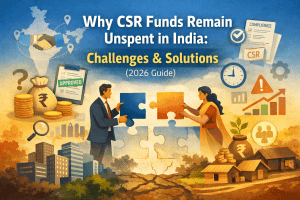
India’s CSR ecosystem is often described as underfunded or difficult to navigate. But when you look closely at how CSR in India actually works, a different reality emerges.
India does not have a CSR funding gap. It has a CSR coordination gap.
This distinction matters, because solving for funding versus solving for coordination requires completely different approaches.
CSR in India (FY 2026)
India’s CSR ecosystem continues to grow in both scale and complexity. In Financial Year 2026, CSR spending is estimated at ₹34,900+ crore, making it one of the largest CSR markets globally.
However, despite this scale, inefficiencies persist:
- ₹1,500–₹2,000 crore remains unspent each year
- CSR funding is often concentrated among a limited set of large NGOs
- Many credible, high-impact NGOs still struggle to access funding
What this really means is that CSR fund utilization in India is uneven and inefficient, not insufficient. And when CSR funds are unutilized, legally it is mandatory to transfer this to unspent CSR account within 30 days.
Why CSR Funds Remain Underutilised in India
- The NGO Discovery Problem
One of the biggest challenges in CSR implementation in India is simply finding the right NGO partner.
CSR teams are expected to identify organisations that meet strict criteria, including legal compliance (such as 12A and 80G registrations), strong governance, financial transparency, and the ability to deliver measurable impact at scale. While thousands of NGOs operate across India, very few are presented in a way that makes them easy to evaluate and compare.
So the issue is not that credible NGOs don’t exist.
It’s that they are difficult to discover, assess, and shortlist efficiently.
This slows down decision-making and often leads corporates to rely on familiar partners instead of exploring new, potentially high-impact organisations.
- Complex CSR Compliance and ESG Alignment
CSR in India is not just about giving. It is tightly linked to compliance, governance, and accountability.
- Every CSR decision must align with:
- The Companies Act and Schedule VII guidelines
- ESG (Environmental, Social, Governance) commitments
- Internal approval systems and board oversight
- Audit and reporting requirements.
Because of this, CSR teams operate in a high-risk, high-accountability environment.
Even when a project is strong, it may not move forward if:
- Documentation is incomplete
- Impact metrics are unclear
- Reporting frameworks are not aligned
As a result, CSR funds often remain unallocated despite clear intent to deploy them.
- Misalignment Between Corporates and NGOs
Another critical challenge in CSR partnerships in India is the communication gap between corporates and NGOs.
Corporates tend to prioritise ESG compliance, metrics, and risk mitigation, while NGOs focus more on community impact, program delivery, and long-term outcomes. Both perspectives are valid, but they operate in different frameworks.
This misalignment leads to:
- Strong grassroots programs being rejected due to poor documentation
- CSR teams struggling to interpret real impact on the ground
- NGOs finding it difficult to present their work in CSR-ready formats
In many cases, good work is not funded simply because it is not communicated in the language CSR teams require.
- Risk Aversion and Limited NGO Access
CSR teams are accountable to multiple stakeholders, including boards, auditors, and the public. This naturally leads to a cautious approach.
Most corporates prefer working with:
- Established NGOs
- Previously funded partners
- Organisations with strong documentation and visibility
While this reduces risk, it also creates unintended consequences.
Smaller or mid-sized NGOs, even when doing impactful work, often struggle to access CSR funding. Over time, this leads to concentration of CSR funds within a limited ecosystem, reducing diversity and innovation in social impact.
- Short-Term CSR Funding vs Long-Term Impact
A large portion of CSR funding in India is still structured as annual or project-based support.
However, real social change requires:
- Multi-year funding commitments
- Continuous monitoring and evaluation
- Capacity building for NGOs
When funding cycles are short-term, but impact goals are long-term, programs struggle to scale or sustain outcomes.
This creates a gap between CSR intent and actual long-term impact.
What This Means for CSR in India
When these challenges come together, the outcome is predictable.
CSR budgets remain partially unspent, NGOs continue to face funding gaps, and corporates spend significant time on due diligence and partner validation. Meanwhile, communities experience delays in receiving support despite the availability of funds.
The issue, therefore, is not a lack of intent or resources.
It is system inefficiency driven by poor coordination.
Why CSR–NGO Partnerships Need to Evolve
As CSR budgets continue to grow, the focus must shift from allocation to execution.
The next phase of corporate social responsibility in India will depend on:
- Faster and more structured NGO discovery
- Standardised due diligence processes
- Better alignment between impact and compliance
- Long-term, partnership-driven funding models
Stronger collaboration between corporates and NGOs is no longer optional. It is essential for improving CSR impact and fund utilisation in India.
How HelpYourNGO Supports CSR Implementation in India
HelpYourNGO works to bridge the gap between corporates and NGOs by reducing friction across the CSR lifecycle.
It enables verified NGO discovery, giving corporates access to a curated network of 750+ vetted organisations with established compliance, governance, and impact credentials. This significantly reduces the time and effort required to identify reliable partners.
At the same time, HelpYourNGO supports NGOs in aligning with CSR expectations by helping structure proposals, define measurable outcomes, and create reporting frameworks that meet corporate requirements. This improves both approval rates and clarity in communication.
Beyond matchmaking, the platform also supports ongoing monitoring, evaluation, and long-term partnership building. The result is a more efficient CSR process with faster deployment, lower risk, and stronger, measurable impact.
The Future of CSR in India
India’s CSR ecosystem is entering a more mature phase.
Budgets will continue to increase. Compliance requirements will become more stringent. Expectations around measurable impact will rise.
The organisations that succeed in this environment will not just allocate funds effectively, but deploy them efficiently through the right partnerships and systems.
The question is no longer:
“Is there enough CSR funding in India?”
The real question is:
“How effectively can we use it?”
Looking to Strengthen Your CSR Strategy?
If you are looking to identify credible NGOs, streamline CSR compliance, or improve the impact of your CSR investments, the right partnerships can make a significant difference.
HelpYourNGO supports organisations in building credible, compliant, and high-impact CSR programs that are aligned with both business goals and social outcomes.


